
The Future Arrives in Lisbon – AGAIN
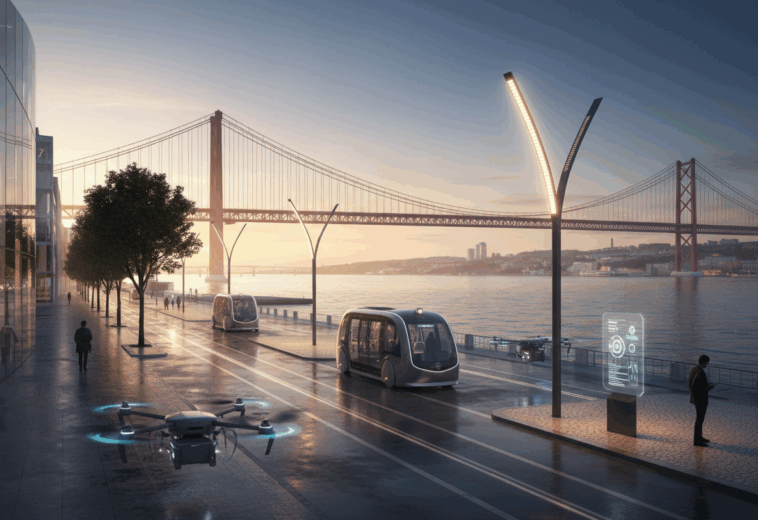
Big Waves Crashing: Five Tech Trends That Will Define 2025-2030
“The best way to predict the future is to create it.”
– Alan Kay
Welcome to the Lab: Lisbon 2010 → Lisbon 2025 and Beyond
I arrived in Lisbon back in 2010. It was charming, yes, but modest in its tech-ambitions. Start-ups, incubators, early co-working spaces – the spark was there, but the flame was just flickering. I remember sitting in a tiny café in Alfama, thinking: there’s more here than meets the eye.
Now, it’s 2025. And this city host of Web Summit 2025 (Nov 10-13) is no longer just part of the global tech scene – it’s one of its main stages. The event is expected to draw over 70,000 attendees from across the ecosystem.
It’s been convenient for me: being based here in Portugal, yet travelling globally, means I’ve watched Lisbon evolve in real-time, and I’ve also seen the global strokes. I’ve talked to entrepreneurs in Lisbon, investors in New York, technologists in Seoul. The combination gives a special vantage point: global trends meet local ground. And that’s what I want to share now.
Big Waves Crashing: Five Tech Trends That WebSummit Will Define (2025-2030)
Let’s skip the fluff. Here are the big ones I see, grounded in my experience, that will reshape how we live, move, build.
1. Intelligence Everywhere, Not Just in Clouds
We used to talk about cloud computing like it was the future. Now, the future is here: AI at the edge, quantum assistance, sensors everywhere. Mobility corridors, city-infrastructure, logistics — everything is becoming smarter, faster, more reactive.
For example, experiments with quantum computing in traffic/navigation show what’s possible.
My forecast 2027-2030: Entire mobility flows will adjust in milliseconds. Cars, trucks, bikes, people – all orchestrated by unseen intelligence. Lisbon will see these patterns first.
2. Mobility + Supply-Chain + City as One Nervous System
For years we treated mobility, supply-chain and urban systems as separate. We shouldn’t anymore. The drone delivering your parcel, the autonomous shuttle picking you up, the smart curb in front of your door—they’re all part of the same ecosystem.
The advantage goes to those who orchestrate, not just build components.
Forecast 2028: Supply-chains become urban services. Logistics integrates with city mobility. Lisbon + partner cities form smart-nodes in a network.
3. Cities as Real-Time Living Infrastructure
If “smart cities” used to be sensors and dashboards, the next phase is living cities: ones that sense, learn, adapt. Your city becomes like a body: stimuli come in, output goes out, systems adjust.
Data without action is useless. Living infrastructure means action.
Forecast 2030-2035: Interactivity will feel normal. You’ll ask your city for something and it will respond in real time. Lisbon will be piloting this wave.
4. Sustainability, Circularity & Resilience as Default
Green was once optional. Now resilience is mandatory. Because climate, geopolitics, supply disruptions—they’re real. The winners will embed sustainability in the bloodstream of their systems—not as an afterthought.
Forecast 2029: You’ll subscribe to mobility services, resource-services, logistics-services. Ownership fades; access, re-use and flexibility become the norm.
5. Human-Centric Tech: The Reverse of the Tech-Tyrant
Technology must be loved, not feared. One of the mistakes I see is building tech for tech’s sake. The winners will build experiences that feel invisible because they simply work.
Forecast 2026-2028: Platforms that deliver outcomes (not just features) will win hearts. Lisbon’s creative trend, its human-scale culture, will advantage this movement.
Why Web Summit 2025 (Lisbon) Matters – From My Insider Lens
You might ask: “Why bother with one conference?” My answer: Because this is our moment. And yes, I’m here for more than a keynote speech or booth visit—I’m here to connect, influence, co-create.
Global scale, local grounding
Web Summit in Lisbon bristles with global energy. With over 800 speakers, 320 partners, media from every corner.
Because I know Lisbon’s local fabric, I can spot startups that are rooted here but thinking global; I can spot global players looking to partner locally. That duality is rare.
Unity of thinking and action
It’s not just about listening. It’s about doing. Meeting startups in mobility/supply-chain. Talking to city-leaders about how to deploy living infrastructure. Sitting across from corporates asking: what’s your ecosystem strategy?
I’ll arrive in Lisbon with three strong priorities:
Find early-stage mobility/logistics players that think “city + ecosystem” not just “vehicle”.
Engage corporates who realise they need to partner or they will be left behind.
Partner municipalities (yes, I serve one) to bring pilots to life.
Lisbon as the proving ground
Lisbon matters not just because it hosts the event, but because it is a living experiment. The bike lanes in Lisbon, the smart-mobility initiatives, the growing startup ecosystem—they are real.
So when I meet someone talking about “smart city solutions”, I bring them to Lisbon’s local reality: “Can you work here? Can you scale here? Can you adapt to real-citizens, real-traffic, real life?”
My Bold Forecasts Beyond 2025 – Because Why Play Small?
Here are the predictions I’ll stick my reputation on (yes, I’ll happily buy the lunch if I’m wrong).
2026-2027: You will see true “smart-mobility corridors” between European cities: Lisbon ↔ Porto ↔ Madrid. Autonomous fleets, shared micro-hubs, integrated logistics.
2028: Supply-chain invisibility becomes the standard. Goods, energy, mobility flows move so fluidly you barely notice. City streets become ecosystems of resource-flow.
2030: Quantum/edge compute in cities becomes widespread. The city processes trillions of sensor events per second; you rarely experience congestion anymore.
2032: “Resource-as-service” city models. Mobility, energy, waste, logistics—bundled as services you subscribe to. Ownership drops; access rises.
2035: Lisbon and a handful of others become “living urban platforms”. You live in a city that knows you, anticipates you, serves you—and you barely think about the tech behind it.
2038+: We’ll look back and laugh at early-era cities where you queued at traffic lights, parcels took days, and people drove alone to work in GPS-lit boxes.
A Personal Note
I still remember the nervous feeling of pitching a startup to a small group in 2012. I remember the thrill of seeing Lisbon’s startup-scene bloom. I remember the early days of mobility innovation meetings where we were just asking “What if?”.
Today I wake up excited—and slightly impatient. Because the tools are here, the urgency is there, and the stage is set. As someone who works in technology innovation, supply-chain disruption, municipality strategy—I believe we are at a pivot: from “What could be” to “What is”.
If you’re reading this and thinking “I want in” — then good. Whether you’re a founder, innovator, city-planner, investor or dreamer—this is our moment. Attend Web Summit 2025, show up in Lisbon, connect, act. Use the event not just as a chance to listen—but to launch.
Because the future doesn’t wait for lofty mission-statements. It shows up. And Lisbon will be one of its stages.
See you there.
- 352 views